
Artificial Intelligence is increasingly used to support recruitment decisions. However, most hiring tools focus on prediction and recommendation, while human decision-makers remain legally and ethically responsible for the final outcome.
This project explored a critical question:
How might we design AI hiring systems that strengthen human judgment instead of replacing it?
The result was the AI Hiring Co-Pilot, a concept for an AI-powered recruitment platform that helps HR professionals make more thoughtful, transparent, and accountable hiring decisions.
During the research phase, I investigated how recruiters interact with AI-assisted hiring systems.
While AI tools often promise efficiency and objectivity, many create an unintended side effect:
This creates a paradox:
Human-in-the-Loop exists on paper, but not in the interface.
Instead of acting as assistants, AI systems can become silent authorities.
Understand how recruitment professionals use AI recommendations during hiring decisions and identify opportunities to support reflective decision-making.
I interviewed 8 participants from my Stanford cohort, including professionals with recruitment experience and familiarity with AI-supported hiring processes.
The project started with six hypotheses around Human-Centered AI in recruitment:
H1 – Illusion of Control: Users believe they make independent decisions but often follow AI recommendations under time pressure.
H2 – Transparency ≠ Understanding: AI explanations are visible but rarely useful for actual decision-making.
H3 – Bias Remains Abstract: Bias only becomes meaningful when users see its direct impact on their own decisions.
H4 – Override Anxiety: Disagreeing with AI feels riskier than accepting a potentially wrong recommendation.
H5 – Responsibility Delegation: The more opaque a system becomes, the more responsibility shifts psychologically to the machine.
H6 – Documentation Changes Behavior: Decision logs can encourage either reflection or defensive behavior.
Five recurring patterns emerged:
1. Recruiters Follow AI More Often Than They Realize
Participants described themselves as decision-makers but often relied on AI recommendations automatically when working under time pressure.
2. Transparency Is Not Enough
Most explainability features were considered interesting but not useful when making actual hiring decisions.
3. Bias Needs To Be Actionable
Participants only engaged with bias information when they could see how it affected a candidate evaluation.
4. Overriding AI Feels Risky
Users often needed strong justification before disagreeing with an algorithm.
5. The Real Problem Is Accountability
Many participants were not struggling with making decisions.
H6 – Documentation Changes Behavior: Decision logs can encourage either reflection or defensive behavior.
Instead of asking:
Decision-Relevant Explanations
Show consequences, not model internals.
Guided Overrides
Make disagreement with AI easier and safer.
Counterfactual Thinking
Allow users to explore how outcomes change under different conditions.
Accountability Support
Capture reasoning rather than simply logging actions.
Actionable Bias Transparency
Make bias visible and investigable.
The concept was built around five Human-Centered AI principles:
How can AI make better hiring decisions?
I reframed the challenge:
How can AI help humans make better hiring decisions?
This shift moved the project from automation toward Intelligence Augmentation.
AI as a Cognitive Co-Pilot
The proposed solution is an AI-powered HR SaaS platform that acts as a cognitive partner rather than an automated evaluator.
The AI:
- Analyzes applications
- Highlights uncertainty
- Explains its reasoning
- Supports reflection
The AI does not:
- Select candidates
- Make hiring decisions
- Rank applicants automatically
- Act as the final authority
The human remains responsible throughout the process.
Candidate Application
          ↓
AI Analysis
          ↓
Shared Human–AI Workspace
          ↓
Explainability & Exploration
          ↓
Human Decision
          ↓
Accountability Documentation
          ↓
Ethical Review & Model GovernanceThe project combines research findings, explainability and ethical safeguards into a single decision-support model.
Research Insights
        ↓
Problem Hypotheses
        ↓
Human-Centered AI Principles
        ↓
Shared Representation
        ↓
Counterfactual Exploration
        ↓
Human Decision
        ↓
Accountability Documentation
        ↓
Bias Monitoring & Ethics Review
        ↓
Responsible Model Improvement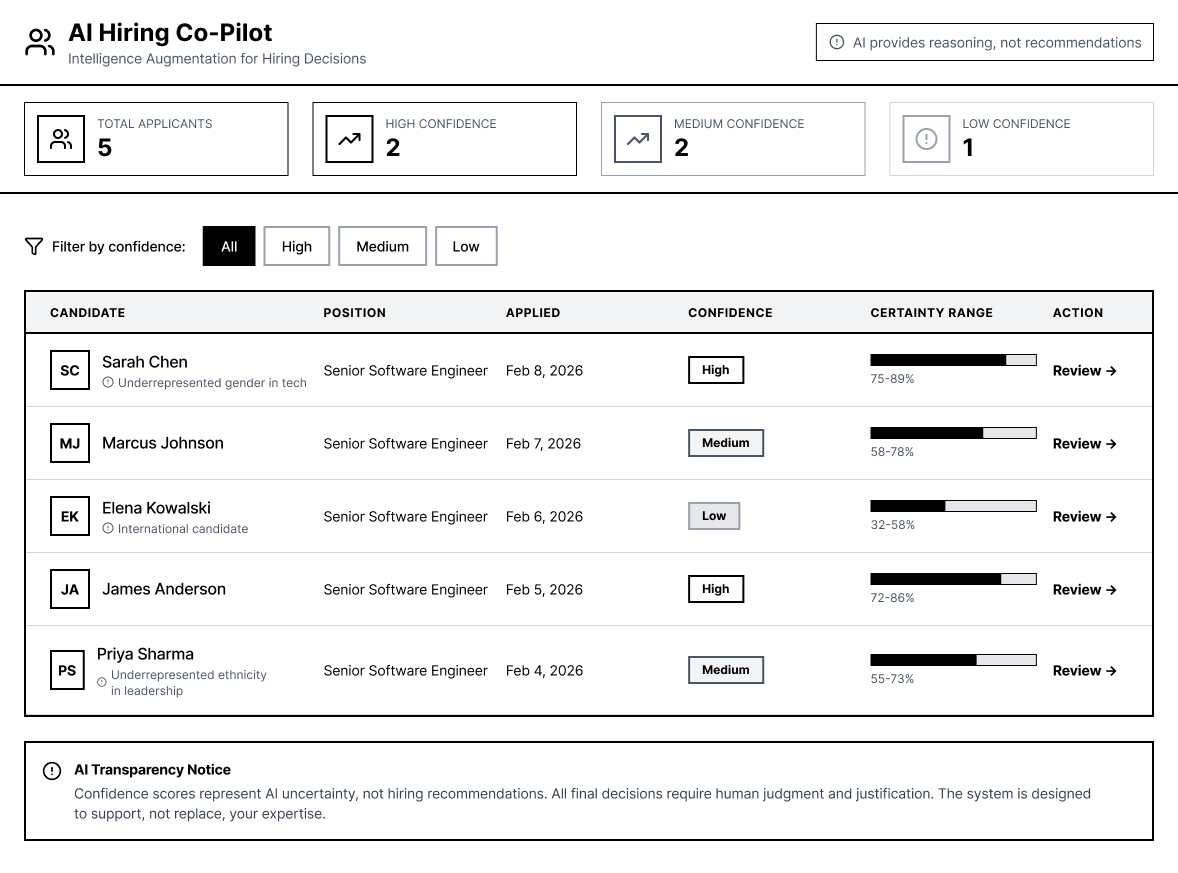
The overview screen intentionally avoids traditional ranking patterns.
Instead of showing “Best Candidate”, it presents:
This shifts the focus from selection to exploration.
Many AI products unintentionally encourage automation bias through ranking systems. This design attempts to reduce that effect by visualizing uncertainty rather than certainty.
This screen represents the core innovation of the project. The AI reasoning process becomes visible through a three-layer explainability model.
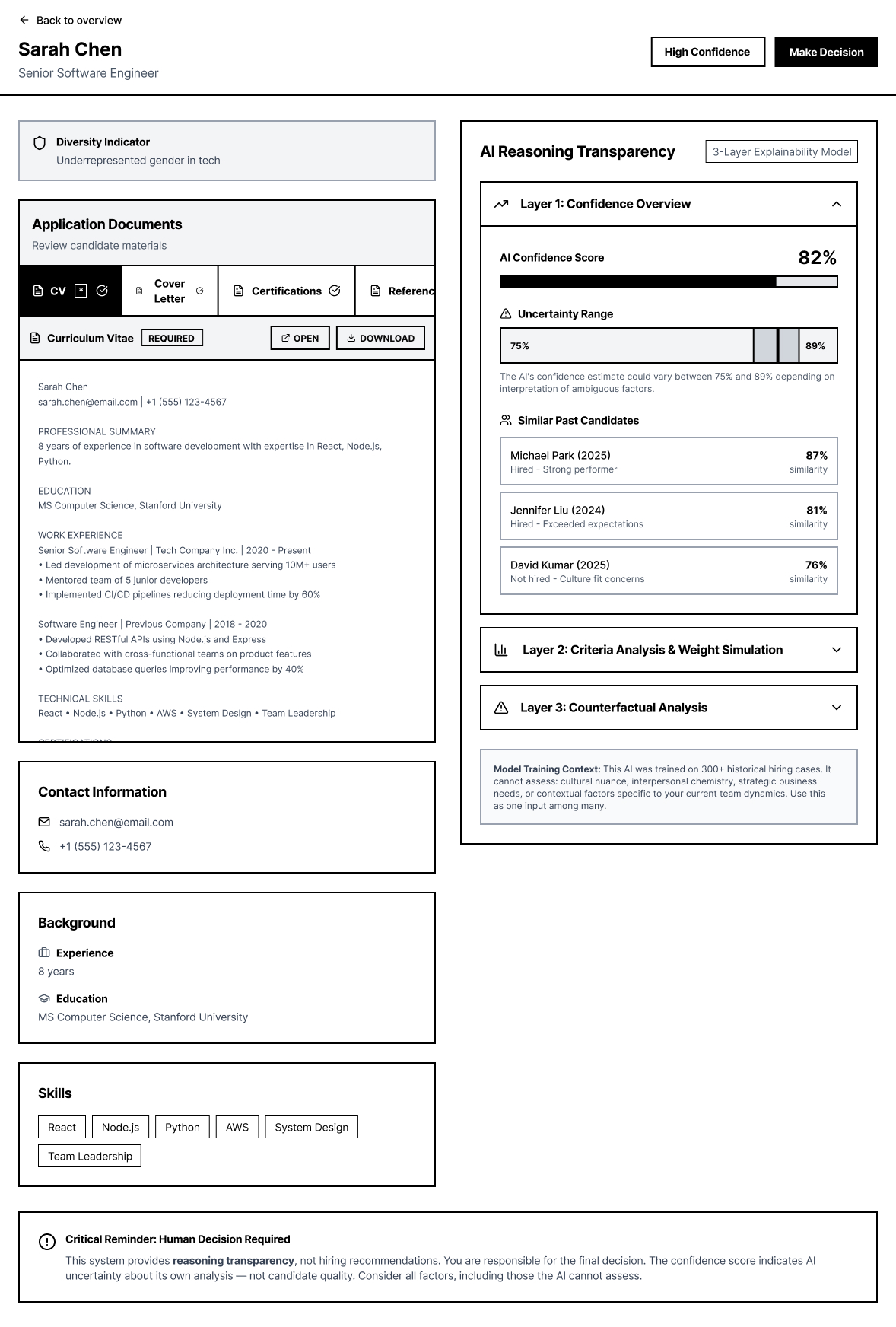
Provides:
The goal is not prediction but calibration of trust.
Provides:
Users can explore:
What happens if leadership experience becomes more important than technical skills?
Users can investigate:
How would the assessment change if the candidate had two additional years of experience?
Counterfactual reasoning was identified as one of the strongest opportunities to improve reflective decision-making.
One of the most important findings from the research was that users often hesitate to override AI recommendations. To address this, I designed a structured override mechanism.
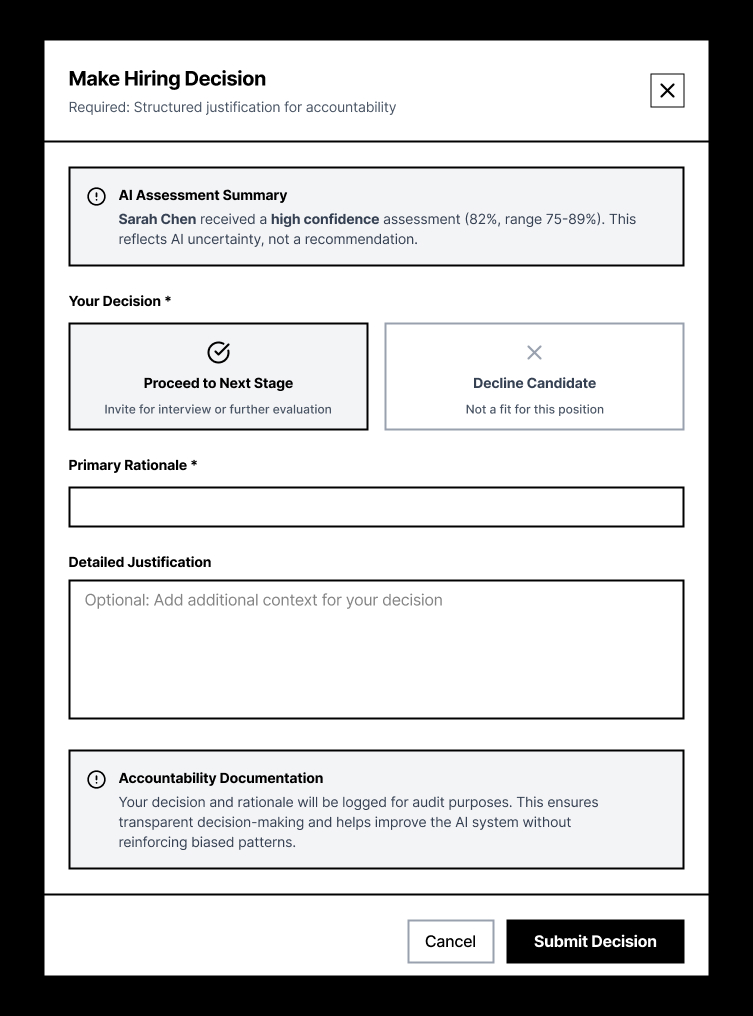
When making a decision, users must:
The goal is not compliance. The goal is reflection.
Beyond interface design, I explored how prompt engineering can reinforce responsible AI behavior. The system prompt was intentionally designed with strict authority boundaries.
The AI:
The AI is explicitly prohibited from:
This ensures that Human-in-the-Loop exists not only in the interface but also within the AI’s behavior.
Responsible AI was a core component of the project rather than a final checklist exercise.
The ethics review examined:
The concept incorporates several mitigation strategies:
This project fundamentally changed how I think about AI products.
The most valuable insight was:
The future of AI UX is not making machines smarter. It is helping humans make better decisions.
Many AI products focus on prediction accuracy.
This project explored a different direction:
UX Research
AI Product Design
Product Strategy
AI Governance
This project was created as an individual capstone project as part of the Stanford Online course “UI/UX Design for AI Products”.
The AI Hiring Co-Pilot is a conceptual study project developed for educational purposes. The product was not implemented in a production environment, and the presented research findings, concepts, wireframes, and ethical frameworks were created to explore Human-Centered AI design principles in recruitment and decision-support systems.